Every AI integration proposal contains a number for the model API, and that number is almost always correct. It is also almost always the least useful number in the document, because it is the one line item that scales down when you switch models and the one that nobody was going to be surprised by.
This is an attempt at the rest of the invoice. The prices below are published list prices with the date they were checked; the ranges are labelled as ranges; and where a number comes from a vendor or a consultancy rather than a study, it says so.
The line item everyone quotes
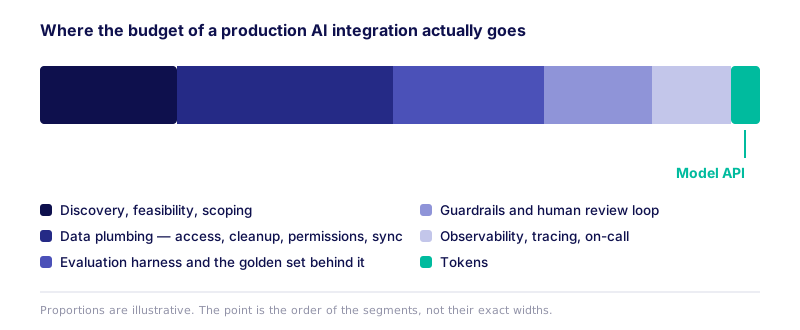
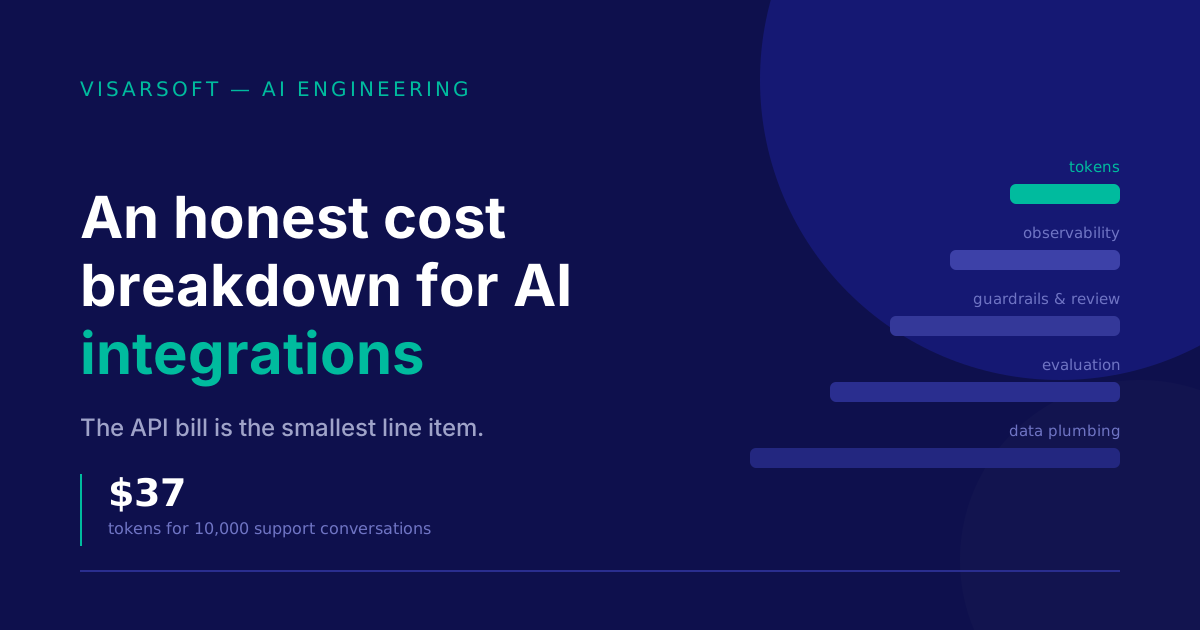
The shape above is the entire argument of this article, so it is worth being clear about what it is and is not. The widths are illustrative — your project will have its own proportions. The order is not illustrative. In every integration into an existing product, the token bill is the last segment, and it is a sliver.
The reason is structural. Tokens are the only part of the system that a vendor has already built, priced, and made someone else operate. Everything to the left of them is work that exists precisely because your software already exists — and that work does not get cheaper when the models get cheaper.
What the token bill actually looks like
Numbers first, so the rest of the article has something to be measured against. As of July 2026, published Claude API list prices are $1 / $5 per million input / output tokens for Haiku 4.5, $2 / $10 for Sonnet 5 through 31 August 2026 ($3 / $15 after that), and $5 / $25 for Opus. The Batch API takes 50% off both sides, and a prompt-cache read costs 10% of the base input rate. Full price table.
Abstract per-token prices are hard to feel, so take the worked example straight from the vendor documentation: ten thousand support conversations, averaging around 3,700 tokens each, on Haiku 4.5.
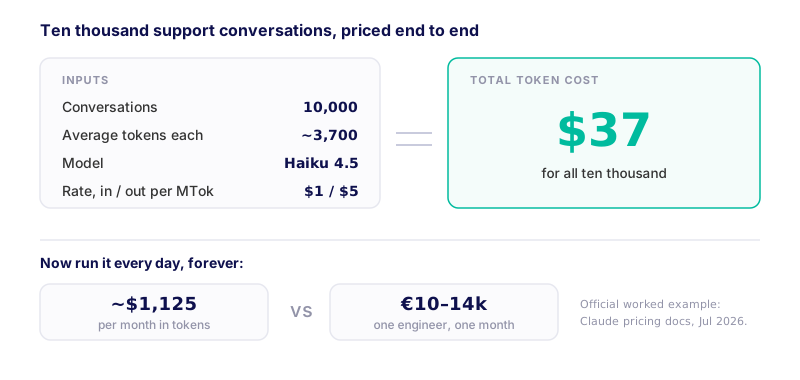
Thirty-seven dollars. For ten thousand conversations.
Scale that to ten thousand conversations every single day and you land near $1,125 a month — that part is our arithmetic, not the vendor's. Set it beside a fully-loaded senior engineer month in the DACH region, which we treat throughout as €10,000 to €14,000. That figure is an assumption, not a source; substitute your own and the conclusion does not move. The tokens cost roughly a tenth of one person.
Two caveats worth stating, because they are the ways this number goes wrong in practice. Retrieval-heavy systems stuff far more context into each call than a support reply does, and agentic loops make several model calls per user action rather than one. Both can move you an order of magnitude. Neither changes the ranking of the segments.
The work before the first prompt
The most expensive discovery you can make is at the end. MIT's The GenAI Divide: State of AI in Business 2025 — 52 executive interviews, 153 leader surveys and an analysis of 300 public deployments — found that 95% of pilots delivered no measurable P&L impact, against $30–40bn of enterprise investment. Coverage of the report.
That statistic is usually deployed as a warning about AI. Read as a budget item it says something more useful: the cheapest week in the whole project is the one where you establish, on paper, what a good answer looks like and how you would know you had one. A two-week feasibility spike that kills a bad idea is not overhead — it is the highest-return line in the budget.
- Write down the acceptance bar first. "Correct 9 times out of 10 on these 50 real cases, and visibly unsure on the rest" is a specification. "Better than what we have" is not.
- Cost the boring path too. A search box, a lookup table or a rules engine sometimes clears the same bar for a tenth of the money. Finding that out in week two is a win, not a failure.
Data plumbing is the real integration
This is the segment that surprises people, and it is the largest one. Industry estimates — from consultancies rather than studies, so treat them as directional — commonly put data preparation alone at 20 to 40% of project budget.
It is large because integrating into software that already exists means inheriting every decision that software has already made. The model needs the data, and the data is behind an API written in 2016, in a schema nobody has permission to change, with access rules encoded in a permissions table that the AI feature must now respect exactly — because a summary that leaks one row across a tenant boundary is a breach, not a bug.
- Permissions are the hard part. Retrieval has to be filtered by the same rules as the rest of the product, at query time, per user. Retrofitting that onto an index built without it is a rebuild.
- Freshness is a pipeline, not a setting. Something has to notice a record changed and re-embed it. That something needs monitoring, back-pressure and a replay path.
- Deletion has to actually delete. Under GDPR a deleted record must also leave your vector store, your caches and your eval fixtures. Each of those is a separate piece of work.
None of this is AI work. All of it is on the critical path, and none of it can be bought.
Evaluation: the cost nobody budgets
Traditional software has a property that makes it cheap to change: you can tell whether you broke it. A test suite is a decision procedure. Prompt-driven software has no equivalent by default, so you have to build one, and then you have to keep it alive.
The build is a golden set: real inputs with human-agreed correct outputs, covering the ordinary cases and, more importantly, the ones where the right answer is "I don't know." Fifty cases is a usable start, a few hundred is a real suite, and the cost is a domain expert's time rather than an engineer's — which is often harder to get.
The maintenance is the part that never appears in a proposal. The eval set decays every time the product changes, every time the corpus changes, and every time a model is deprecated and you have to re-qualify its replacement. Budget it as a standing percentage of the team, not as a project phase.
Guardrails and the human in the middle
Every AI feature that touches a customer needs an answer to "what happens when it is wrong?", and that answer has a running cost with a name and a rota attached.
- Suggest, do not act. The cheapest guardrail is a design decision: a draft a human sends beats an email the system sent. It costs a click and removes an entire class of incident.
- Sampled review, forever. Someone reads a percentage of outputs every week. This is not a launch activity; it is how you find out the quality moved.
- A refusal path that works. The system needs to be able to say it does not know and hand over cleanly. Designing and staffing that handover is real product work.
In a regulated setting add an audit trail: which model version, which retrieved documents, which prompt, for every output, retained for as long as the regulator says. That is a schema, a storage bill and a retention policy.
Running it: observability and drift
A normal production incident gives you a stack trace. An AI incident gives you a screenshot from a customer and a shrug. Closing that gap means trace-level tooling that captures the prompt, the retrieved context, the tool calls, the completion, the latency and the token spend for every request — because without the retrieved context you cannot tell a bad answer from a bad retrieval, and those have completely different fixes.
Consultancy estimates put dedicated monitoring and observability tooling at roughly $30,000 to $100,000 a year. Again: vendor-adjacent figures, useful as an order of magnitude rather than a quote. The storage is the quiet part — full traces of every request are large, and retention is a cost decision you will make twice, once at launch and once when the bill arrives.
Then there is drift, which has no analogue in ordinary software. Your inputs change as the business changes, your corpus changes as people write documents, and your model gets deprecated on the vendor's timetable rather than yours. Each of those is a re-qualification against the eval set you built in section five, which is the strongest argument for having built it.
Three scenarios, three budgets
The word "AI integration" covers work that differs by an order of magnitude, which is why headline benchmarks are useless. These are shapes to locate your own project against.
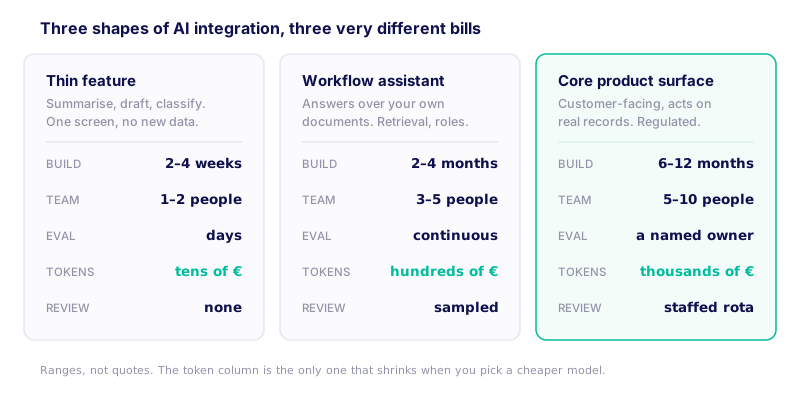
Read across the rows rather than down the columns. Moving from the first column to the third multiplies build time by roughly five and team size by roughly five, and it multiplies the token bill by rather less than that. The expensive axis is not usage. It is consequence: what happens when the output is wrong, and how much machinery you need so that the answer is "not much."
One-time versus recurring
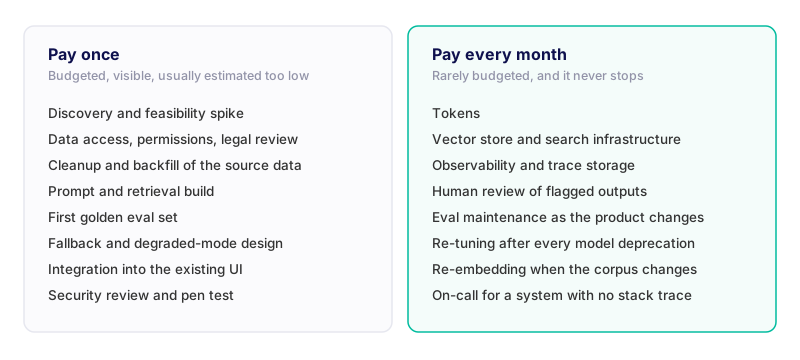
The left-hand column is what gets estimated. The right-hand column is what gets discovered, usually in the second quarter after launch, usually by someone asking why the team that shipped the feature is still fully allocated to it.
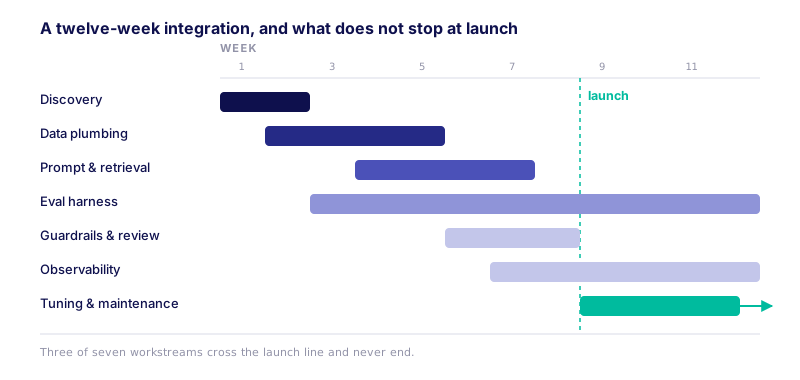
Three of the seven workstreams cross the launch line and never come back. If your plan has a date on which the project ends, it is describing the first column only.
Consultancy estimates suggest the commonly-missed items — data cleanup, stakeholder time, access-control work, fallback design, legal review, four to eight weeks of post-launch tuning, observability — add 30 to 60% on top of the headline implementation cost, and that 85% of organisations misestimate AI project costs by more than 10%. Directional figures from vendors, not a study. But they are directionally consistent with the shape of the first diagram, which is the point.
What to check before you sign anything
- Ask what the acceptance bar is. If nobody can state it as a number on a named set of real cases, the proposal has no definition of done and no way to tell you it is finished.
- Ask who maintains the eval set. By name, and for how long. This is the single question that separates a proposal that has run one of these from a proposal that has read about them.
- Ask for the recurring column. Tokens, infrastructure, review time, eval maintenance, month twelve. If the quote is a single number with no monthly line, it is quoting a prototype.
- Ask what happens when the model is deprecated. It will be, on a schedule you do not control. The answer should be a re-qualification run, not a silence.
- Ask what the non-AI version costs. Sometimes it is a tenth of the price and clears the same bar. A partner who has priced that option is worth more than one who has not.
The token bill is the one number in the proposal you can safely ignore. It is also, almost always, the only one anybody argued about.