What changed in development over the last three years
Not long ago the daily work of a developer looked the same for many years. You wrote every line by hand, searched Stack Overflow for answers, and spent days getting familiar with a new codebase. That changed quickly.
Here is a short breakdown of what is genuinely different today:
- Code generation. Boilerplate and repetitive patterns always existed. Developers tried to solve this with templates, snippets, and copy-paste from old projects. Now AI handles it directly — it reads the context and generates what is needed.
- Debugging. Finding and explaining errors was always manual work. You read the stack trace, searched for the message, tried to understand what went wrong. Now you paste the error and get an explanation with a suggested fix in seconds.
- Understanding new code. Getting familiar with an unfamiliar codebase used to mean days of reading. Now you can ask, and AI walks you through it.
- Test writing. Tests were often skipped or delayed because of how long they took to write manually. Now the first version is generated automatically and the developer reviews and adjusts.
- Documentation. Nobody liked writing it. Now the first draft is done by AI and the developer edits instead of starting from nothing.
The shift is not that these problems are solved perfectly. It is that the mechanical part of each one became significantly faster.
The gap between AI claims and real development work
Let's start with a small breakdown of what major companies and researchers actually measured.
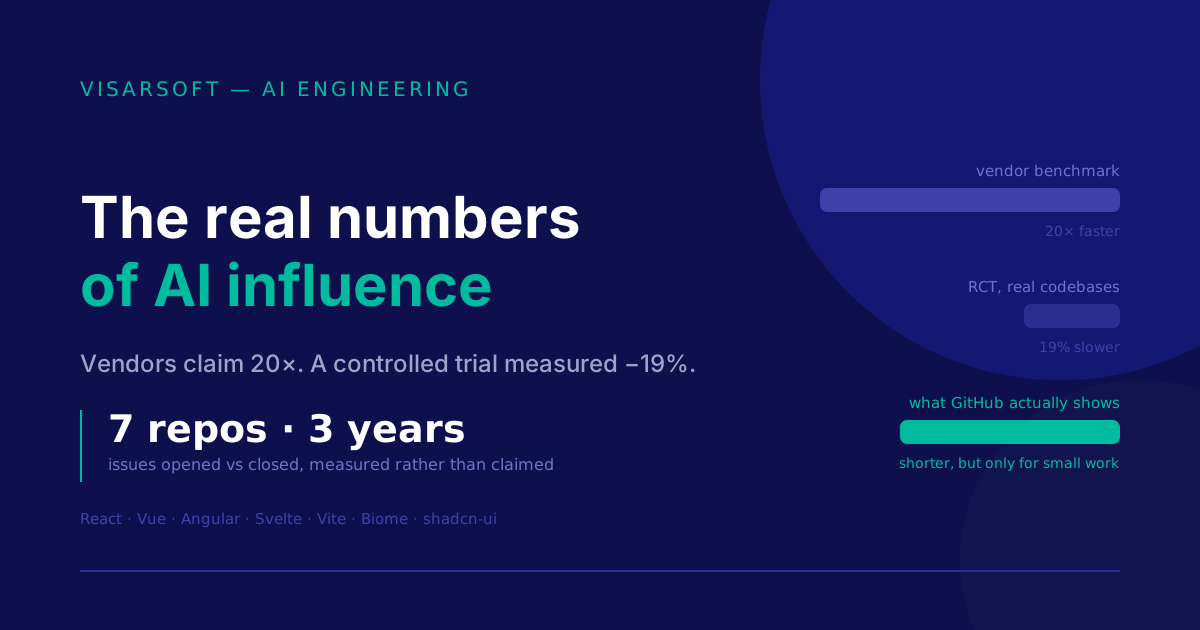
Anthropic's own research shows developers complete isolated tasks 80% faster with AI assistance. GitHub reports 55% faster on similar benchmarks. Microsoft, Google, and Amazon all published numbers in the same range. The headlines write themselves.
But here's what doesn't make the press release.
- METR, an AI safety research organization, ran a proper randomized controlled trial with experienced developers on real open-source projects. Not toy tasks. Not isolated exercises. Real codebases, real tickets. Result: developers with AI tools were 19% slower than those without.
- Google's DORA 2025 report surveyed over 3,000 developers. 90% are using AI tools. 80% say they feel more productive. But 30% say they don't trust the code AI generates — and the report found a negative relationship between AI adoption and software stability.
- Microsoft ran a three-week study tracking actual telemetry — keystrokes, commits, pull requests — alongside developer diaries. Developers felt more productive. The telemetry showed no statistically significant change.
- Stack Overflow's 2025 survey: only 16.3% of developers say AI made them significantly more productive.
This isn't anti-AI. It's the usual pattern with new tools: early benchmarks measure best-case scenarios on well-defined tasks. Real work is messier. The gap between "completes a self-contained function 55% faster" and "ships production features faster" is where most of the nuance lives — and where almost none of the marketing goes.
This isn't anti-AI. It's the usual pattern with new tools: early benchmarks measure best-case scenarios on well-defined tasks. Real work is messier. The gap between "completes a self-contained function 55% faster" and "ships production features faster" is where most of the nuance lives — and where almost none of the marketing goes.
So there's a genuine tension here. Independent researchers measure no significant change in telemetry, or even a slowdown. But real customers, with real budgets, keep paying. And some vendors confidently announce 20x productivity gains.
The question worth asking is: how are those numbers calculated? A 20x improvement on what — exactly? Writing a for-loop, generating a boilerplate file, completing a unit test? These are real speedups on isolated tasks. But a working feature in a production system isn't an isolated task. It's a for-loop plus a code review plus a discussion about edge cases plus a deployment plus a rollback. Measuring one piece and claiming it for the whole is how benchmarks become marketing.
Our investigation using real GitHub data across major frameworks
To understand the real influence of AI on developer productivity, we tracked one measurable signal: the time between when an issue is opened and when it is closed. If AI tooling is genuinely making developers faster, this should show up in how quickly teams resolve new problems over time. The following results cover the most widely used frameworks and tools:
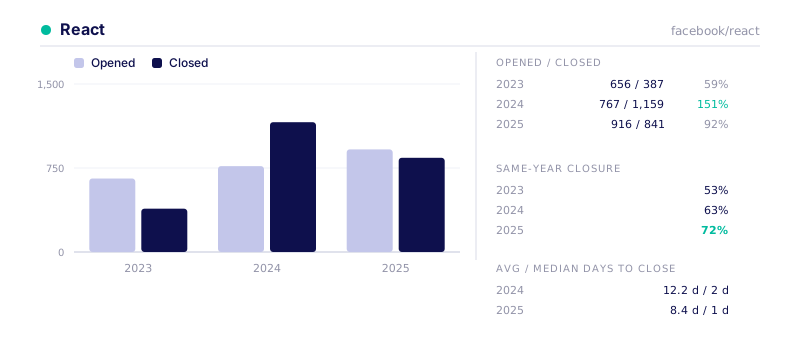
Volatile but recovering — the 2023 dip tracks React 19 development, and by 2025 the team is closing 72% of new issues within the same year, with median time to close down to 1 day.
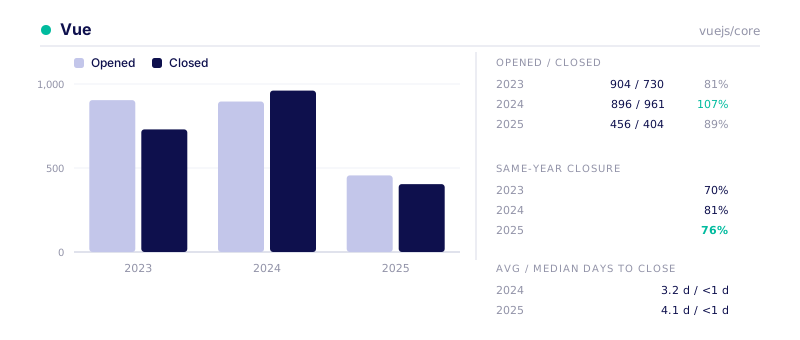
Steady and mature — volume halved over three years, same-year closure rate held at 70–81%, and median time to resolve stayed under 1 day throughout.
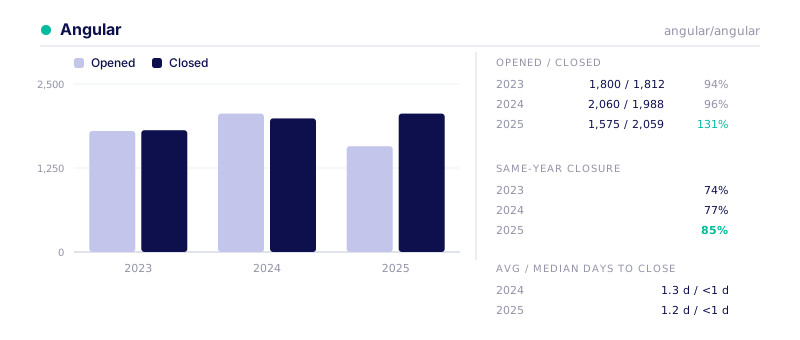
The most consistent performer — closing more issues than it opens in 2025, same-year closure rate at 85%, and median resolution under 1 day across all three years.
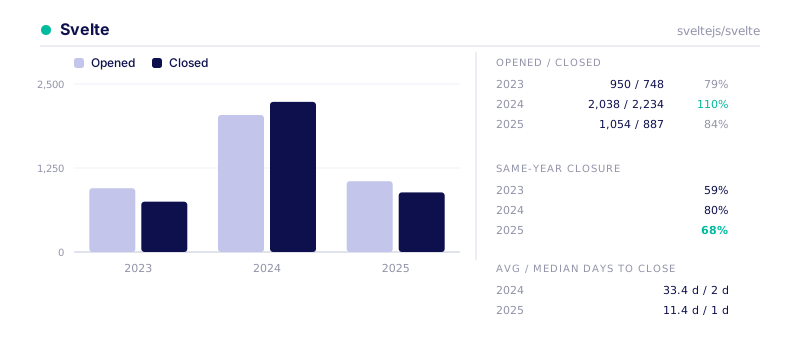
Svelte 5 doubled issue volume in 2024, the team absorbed it — and by 2025 avg days to close fell from 33 to 11, with median down to just 1 day.
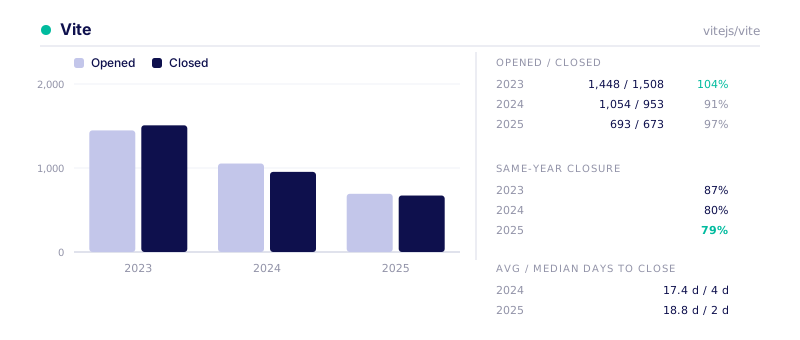
Declining each year as the ecosystem matures, closure rate stable at 79–87%, and median time to close improved from 4 days in 2024 to 2 days in 2025.
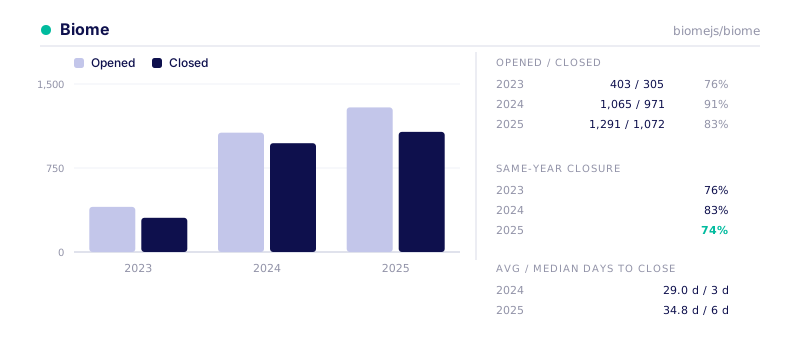
3× volume growth in two years with the same closure rate maintained — though median days to close grew from 3 to 6, showing the team is at capacity.
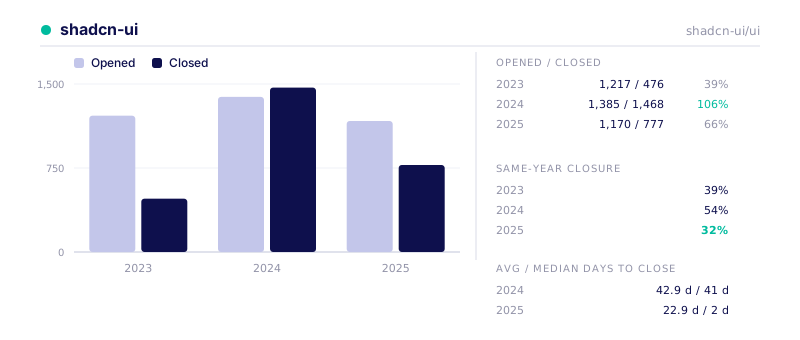
Median time to close dropped dramatically from 41 days in 2024 to just 2 days in 2025 — but only 32% of new issues are resolved within the year, so speed isn’t the whole story.
What the numbers actually show and what to expect
The trend is clear: time to resolve issues is getting shorter across the board. Whether that is because of AI tools, better tooling in general, or more experienced teams is hard to isolate — but the direction is consistent.
What the repositories show is a split pattern. Documentation updates, component changes, small fixes — these are closing faster than before, sometimes significantly. The kind of work that is well-defined, contained, and repeatable is where the acceleration is most visible. That part of the AI promise is real.
Architectural changes tell a different story. Complex decisions, structural refactors, cross-cutting concerns — the timeline on those has not meaningfully shortened. The thinking required does not compress the same way.
What to take from this:
- Simple, repetitive, well-scoped work is now genuinely faster. This is the clearest signal in the data.
- Getting started on a new task or codebase is easier — information is faster to gather and understand.
- Complex architectural work takes the same time it always did. AI assists, but does not replace the judgment required.
- The smarter the use of AI tools — scoped to the right tasks — the more real the return. Using it broadly and expecting uniform gains is where the disconnect between vendor claims and real results comes from.
Use it. But use it where it works.